
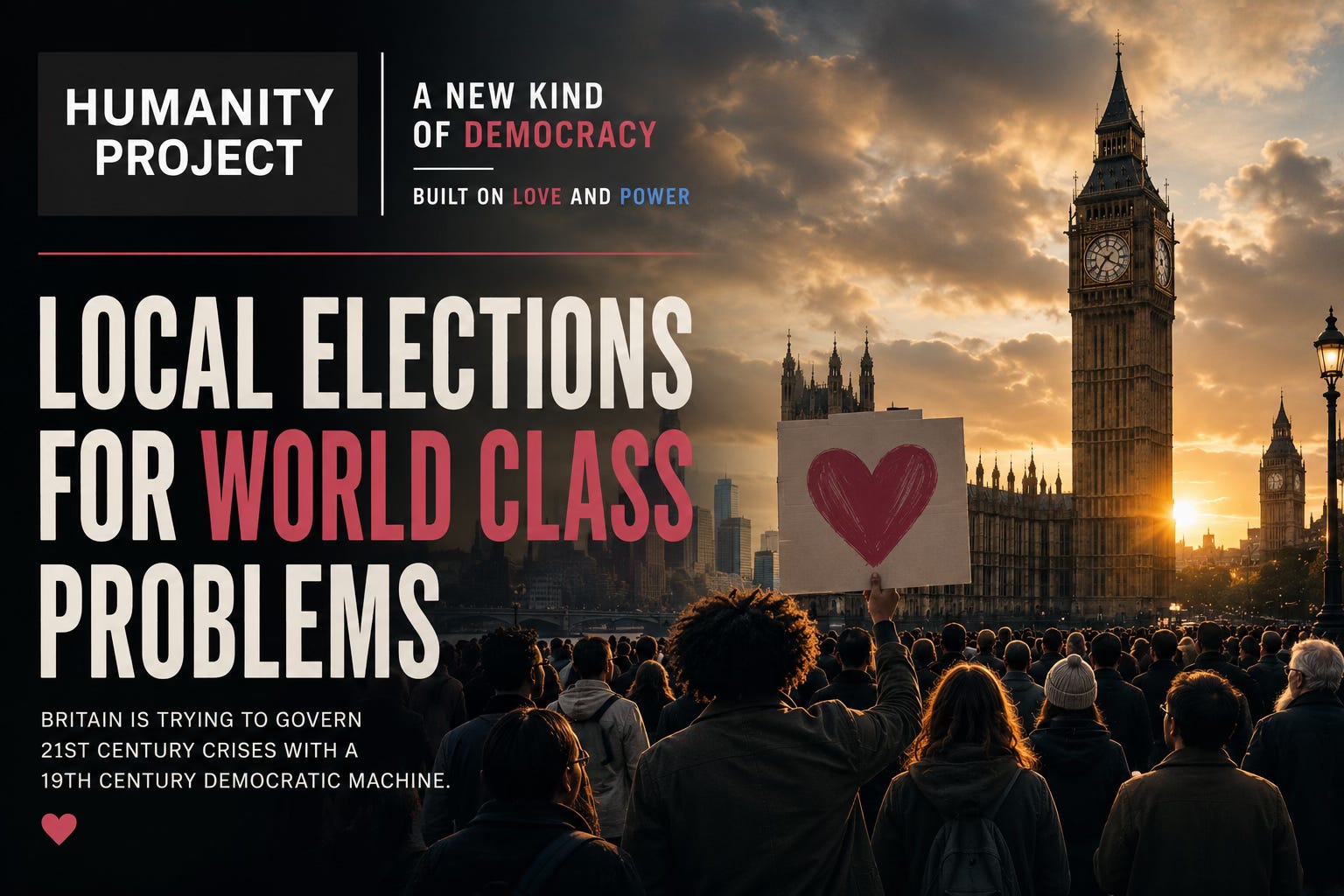
Local Elections for World Class Problems
Britain is trying to govern a century of world class problems with democratic machinery built for another age.

Lee Jasper is co convener of the Humanity Project alongside Clare Farrell, co founder of Extinction Rebellion, and Nick Gardham, CEO of Community Organisers. Together, with the HP team and local assemblies they are working to build a new kind of democracy rooted in love, power, community and renewal from below.
As we wake today to the remarkable disintegration of Britain’s two party political terrain, these local elections expose a deeper and more unsettling truth. Not simply that Labour has suffered a catastrophic defeat, though it has. Not simply that Reform has moved from protest vehicle to institutional power, though it has. Not simply that the Conservatives continue to decay, the Greens are advancing, the Liberal Democrats are recovering ground, and the union is under pressure across Scotland, Wales and Northern Ireland, though all of that matters. The deeper truth is more unsettling. The political ground beneath Britain is breaking apart because the old democratic settlement can no longer contain the complexity of the country it claims to govern.
Westminster will try to reduce this moment to the question it understands best: who survives? Does Starmer stay? Does Burnham return? Does Labour tack left or right? Who briefs, who plots, who resigns, who waits? This is the old theatre doing what the old theatre does. It translates democratic rupture into court politics. It mistakes movement in the palace for movement in the country. But Britain is not suffering from a shortage of leadership speculation. It is suffering from a shortage of democratic imagination.
The local election results have made that brutally clear. Labour has been punished across England, humiliated in Wales, squeezed in Scotland, challenged in London and fractured by voters moving in different directions at once. Reform has not simply won headlines. It has won councillors, councils and political momentum. The Greens have broken through in places Labour once regarded as culturally secure. Plaid Cymru’s advance in Wales and the continuing strength of the SNP in Scotland confirm that the old Westminster centred story of Britain is no longer persuasive across the four nations. This is not routine electoral churn. It is political fragmentation with constitutional consequences.
The danger is obvious. Reform is no longer merely performing insurgency. It is positioning for power. That does not mean Nigel Farage is inevitable. Politics is not weather. But the unthinkable has become thinkable, and that alone should force a serious national reckoning. Reform is dangerous because it converts abandonment into resentment. It takes real pain, insecure work, housing failure, collapsing services, cultural dislocation and social despair, then redirects that pain towards migrants, Muslims, Black communities, liberal elites, public servants and whoever else can be made to carry the burden of national failure. That is not renewal. It is organised nihilism dressed up as plain speaking.
But progressives make a grave mistake when they treat every Reform voter as already lost to racism. Some are racist. Let us not play parlour games with reality. There is a hard racist core within Reform’s appeal and it must be confronted without apology. But many who voted Reform are not committed ideologues of racial nationalism. Many are angry, betrayed and politically homeless. They have watched the Conservatives vandalise public life and Labour arrive speaking the language of managerial repair while seeming unable to feel the moral temperature of the country. For some, Reform was a middle finger vote, not a manifesto. If progressive politics cannot distinguish between hardened bigotry and misdirected despair, it will continue to lose people it should be organising with.
Labour’s crisis is therefore not simply a communication problem, nor is it reducible to the personal unpopularity of Keir Starmer. It is relational, cultural and class based. Too often Labour speaks about working class communities rather than with them. It offers fiscal caution to people living through social emergency. It talks about delivery while many communities are asking whether anyone in power still understands the conditions under which they live. The party’s instinct after defeat will be to commission polling, recalibrate language, sharpen attack lines and search for a safer message. That would be to misunderstand the wound. Labour does not only need better messaging. It needs a deeper relationship with the people it claims to represent.
The recent remarks by the Home Secretary, boasting that she told so called white liberals who challenged her immigration rhetoric to “fuck right off”, captured something rotten in Labour’s current strategic imagination. The problem is not the profanity. Politics can survive a swear word. The problem is the posture behind it: the belief that Labour can rebuild working class trust by performing hardness on migration, insulting sections of its own anti racist and progressive coalition, and mistaking cruelty for seriousness. Those who want Reform will vote Reform. Those who want courage, justice and honesty will look elsewhere. A party cannot triangulate its way back to moral authority.
Stella Creasy is right to warn that Labour cannot respond to defeat through panic promises and a politics that knows the price of everything but the value of nothing. But the problem now runs deeper than Labour’s fiscal messaging. Britain’s democratic system itself has become trapped in the same impoverished logic. It can price welfare, but not abandonment. It can price policing, but not public trust. It can price migration enforcement, but not belonging. It can count votes, but not democratic grief. It can measure turnout, but not the slow collapse of faith that anyone is listening.
That collapse did not begin last week. It has been built over decades. For forty years, Britain has been governed through a neoliberal consensus that told working people to accept insecurity as flexibility, privatisation as efficiency, austerity as discipline, housing speculation as aspiration and democratic distance as professionalism. Public services were hollowed out. Local government was starved. Trade unions were weakened. Civic institutions were allowed to decay. Communities were consulted after power had already made up its mind. Then the same political class expressed shock when people stopped believing the system belonged to them.
Britain has not lost democracy. It has priced it. We have, perhaps outside the United States, one of the best democracies money can buy. Wealthy donors can transform political insurgency into national infrastructure. Billionaire owned platforms can amplify resentment at industrial speed. Corporate lobbying shapes Westminster long before ordinary citizens know a decision is being made. Media power can set the emotional weather of the nation. In such a system, democracy does not disappear overnight. It is hollowed out, softened up, marketised and sold back to the people as choice.
This is why the old defence of the status quo no longer works. Yes, elections matter. Yes, voting matters. Yes, the ballot box is a precious democratic inheritance. But an occasional X in a box cannot carry the democratic weight of climate breakdown, artificial intelligence, racial injustice, mass insecurity, war, migration, loneliness, distrust and ecological crisis. The modern secret ballot, secured in Britain through the Ballot Act of 1872, was a vital democratic advance. But we should be honest about the absurdity of the present moment. We are using Victorian democratic tools and a 20th century party system to govern 21st century planetary emergencies.
That does not mean abandoning representative democracy. It means deepening it before it collapses under the weight of its own insufficiency. Democracy is not only a method for choosing governments. It is a way of living together. It is how people are heard, how power is shared, how conflict is held, how memory is honoured, how trust is repaired and how ordinary people gain the confidence to shape the conditions of their own lives.
This is the argument for a democratic reset. Not as constitutional poetry, but as survival equipment.
A more perfect democracy must also mean a more perfect union across the four nations. The United Kingdom cannot be held together by nostalgia, command, Westminster exceptionalism or a flag waved harder every time consent weakens. Scotland, Wales and Northern Ireland are not regional afterthoughts in an English political drama. They are nations with democratic identities, histories and futures of their own. If Britain is to survive as a union, it must become worthy of consent. That means dignity, shared power, constitutional honesty and democratic renewal from below.
Even Labour’s possible leadership crisis reveals the poverty of the current arrangements. If Starmer falls, the next prime minister could emerge from an internal party process in which the overwhelming majority of citizens have no meaningful voice. That may be constitutionally permissible, but it is democratically threadbare. At a moment when Britain faces war, recession, climate emergency, social fracture and authoritarian populism, the machinery by which power changes hands still assumes a level of trust and deference that no longer exists. This is not an argument for presidentialism. It is an argument for democratic seriousness.
The Humanity Project begins from that seriousness. We are not waiting for Westminster to discover wisdom. We will work with any council, community or civic institution that wishes to deepen democracy, strengthen accountability and rebuild public trust. Over the past two years, through more than forty citizens’ assemblies and community conversations across the country, we have learned how to convene people, hold difficult dialogue, train local organisers, support community movement building and help communities mobilise around the issues they themselves prioritise.
This is not a substitute for national democratic reform. It is the bridge towards it. We need immediate local democratic innovation inside the imperfect system we have, while simultaneously demanding a wider constitutional conversation about the democracy we need. Britain must ask itself what kind of country it wants to become, what citizenship should mean, what rights and responsibilities should bind us together, where executive power should begin and end, how money should be driven out of politics, how lobbying should be made transparent and how communities can become authors of public life rather than spectators of decisions made elsewhere.
The alternative we need is relational democracy. A democracy rooted not only in institutions, but in relationships. Not only in rights, but in responsibilities. Not only in representation, but in participation. Not only in anger, but in encounter. Not only in power, but in love.
Love without power becomes sentiment. Power without love becomes domination. The future requires both. Love as disciplined solidarity. Power as collective agency. Together they become the foundation of democratic renewal.
Culture must sit at the centre of that work because culture is democratic infrastructure. Music, food, faith, humour, memory, sport, story, grief and celebration are not soft extras. They are where people still meet. They are where trust survives after politics has failed. They are where impossible conversations can begin without everyone arriving armed with a party line and a social media reflex. Any politics that cannot sing, mourn, laugh, listen and sit honestly with pain will never rebuild a fractured country.
Councils should be at the front line of this democratic renewal. Not as delivery machines for decisions made elsewhere, but as laboratories of democratic repair. Local assemblies, people’s hearings, youth forums, neighbourhood listening processes, participatory budgeting, cultural organising and community led accountability can help restore the democratic muscle that Westminster has allowed to atrophy. Communities do not need to be endlessly consulted like passive recipients of wisdom from above. They need to be trusted, trained, resourced and invited to co construct power.
This is the practical answer to the false choice now being offered to Britain. On one side, organised resentment. On the other, exhausted management. Reform offers scapegoats. The old parties offer institutional survival. Neither is enough. The country needs organised hope: disciplined, rooted, practical, emotionally intelligent and capable of turning public pain into democratic renewal.
The 20th century democratic model did great things. It helped build the NHS, expand workers’ rights and widen social citizenship. It created institutions that improved millions of lives and gave working people protections their grandparents could scarcely have imagined. But the democratic machinery that helped civilise industrial Britain is no longer sufficient for a fractured, digital, unequal, climate threatened, post imperial 21st century Britain.
The ground is breaking. That is frightening. But broken ground can also be planted.
Britain does not need better slogans from a failing system. It needs a democratic reset rooted in people, place, culture, courage, accountability, love and power.